
The Polar Academy attracts students from around the world
Twenty-one students from ten different countries have experienced first-hand what it means to live and work in Svalbard.
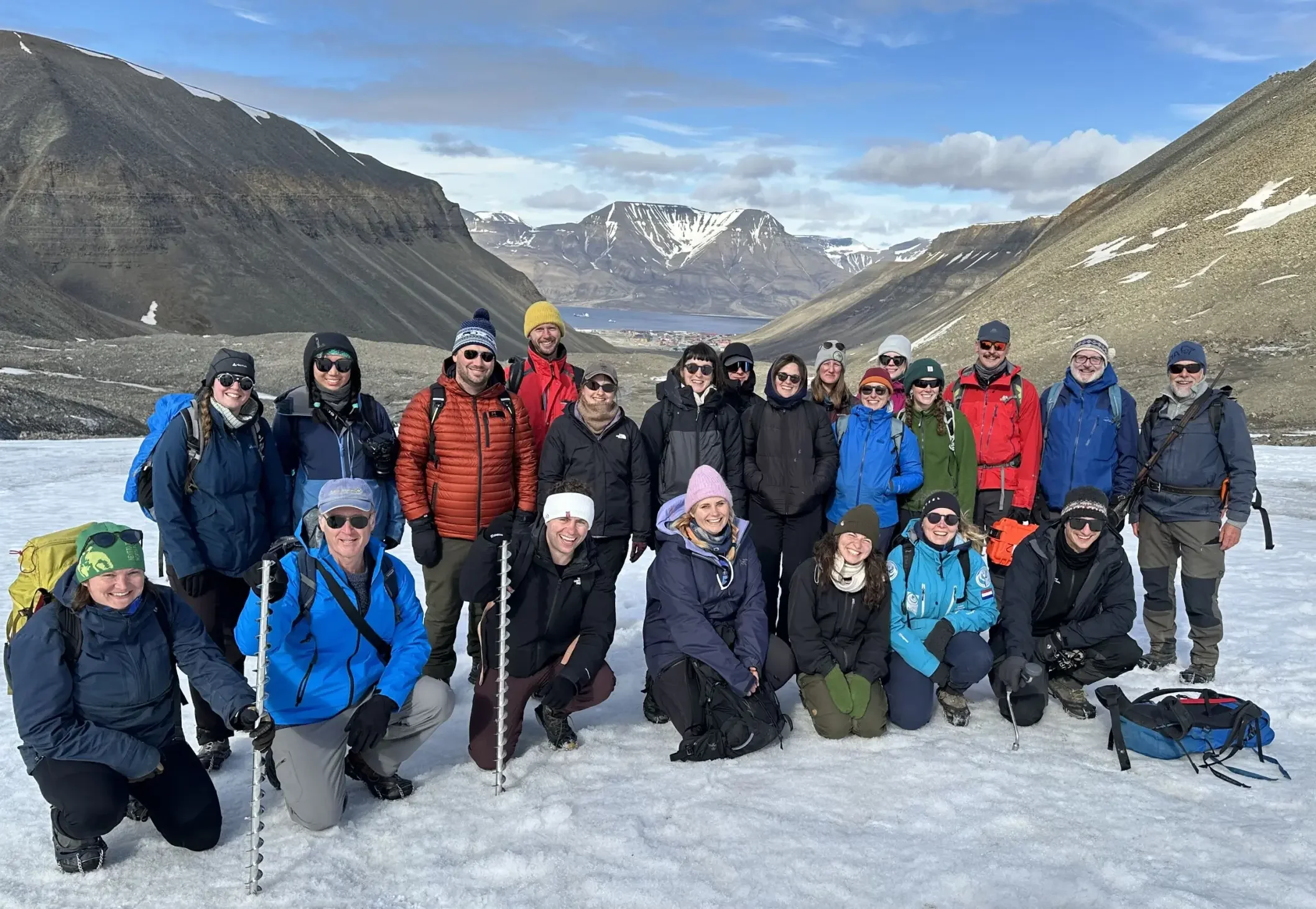
The Polar Academy's international summer school for PhD students and postdoctoral researchers has just concluded. Here, the entire group is pictured at Longyearbreen. Photo: Mike Retelle
In mid-June, the Norwegian Scientific Academy for Polar Research once again hosted its annual international summer school, based at the University Centre in Svalbard (UNIS) in Longyearbyen. PhD students and postdoctoral researchers from the United States, Canada, Germany, the Netherlands, the United Kingdom, Portugal, Romania, Bulgaria, Finland, and Croatia gathered for ten intensive days of lectures, field excursions, and interdisciplinary exploration of the challenges facing the polar regions.
The programme brought together 21 students and 13 lecturers and instructors from Norway, the United Kingdom, the United States, and Canada to explore some of the Arctic's most pressing issues, including geopolitics, climate change, critical minerals, plastic pollution, and the rapid retreat of glaciers.
The Polar Academy's summer schools combine classroom teaching with practical training and fieldwork. The programme opened with discussions on geopolitics and climate change, setting the scene for the themes explored throughout the following days. Students were encouraged to view the Arctic both as an ecosystem undergoing rapid transformation and as a region of increasing geopolitical importance.
Much of the programme focused on the tangible consequences of environmental change: how climate change is reshaping landscapes and communities, how pollution and microplastics are now found in Arctic snow, ice, and wildlife, and how opportunities and challenges arise as critical minerals, local knowledge, and global demand increasingly intersect.
Plastic pollution was a recurring theme throughout the programme, linking local beach clean-ups with international policy initiatives and highlighting the far-reaching impacts of human activity on even the most remote Arctic environments.
The summer school combines practical experience with academic learning. Alongside lectures and discussions at UNIS, participants were given the opportunity to experience life and fieldwork in Svalbard first-hand. They received practical training in Arctic field safety, including polar bear awareness, weather considerations, and safe travel in Arctic terrain.
One of the highlights of the programme was a full-day RIB excursion to Borebukta, where participants experienced glaciers, walruses, and abundant seabird colonies at close range. Standing at the foot of an active glacier while observing the landscapes discussed during the lectures brought scientific concepts and theoretical models vividly to life.
Another field excursion took participants to Longyearbreen, where the combination of scientific methods and Indigenous perspectives offered a broader understanding of what knowledge means in an Arctic context. The excursion demonstrated how local experience and long-term field observations complement satellite data and climate models, and why integrating different knowledge systems is essential for informed decision-making and sustainable management.
The summer school concluded with discussions on climate and ecological tipping points, critical infrastructure, and a simulated crisis management exercise. Participants were challenged to apply their knowledge in practice by making decisions under time pressure, assessing vulnerable infrastructure, and considering how regional tensions might unfold in an Arctic context.
The Polar Academy's summer school demonstrates that Arctic research is no longer confined to a single discipline. Through lectures, glacier hikes, field excursions, and RIB trips, the programme illustrates the importance of dialogue between the natural sciences, social sciences, emergency preparedness, and Indigenous knowledge.
For Longyearbyen, this means that the town continues to be more than a destination for tourism or a former mining settlement—it remains an international centre for education and research, bringing together the next generation of Arctic scholars to better understand a rapidly changing world.
By Bjørn P. Kaltenborn
Vice President
This article was first published in Norwegian in Svalbardposten.